Sociological Methods & Research2026with Peter Esaiasson, Kim Mannemar Sønderskov, Henning Finseraas, Oskar Rönnberg, Jacob Sohlberg & Mari Vaattovaara
The paper argues for the value of conducting surveys in vulnerable neighborhoods and provides a detailed account of a cost-effective strategy for surveying a recognized hard-to-survey population. The approach is illustrated through insights from the Vulnerable Neighborhoods Survey, conducted in three Nordic countries. The strategy focuses on a small number of specific neighborhoods and implements a range of measures to lower participation barriers. A key component involves combining random and non-random sampling techniques to facilitate the recruitment of a broad segment of residents. According to comparisons with registry data, the strategy produces samples that resemble the population on multiple demographic factors.
The Journal of Politics2026with Martin Vinæs Larsen
Responding to important societal challenges often requires physical changes in local communities. Yet such changes frequently encounter strong “not-in-my-backyard” (nimby) opposition. Existing research typically attributes nimbyism to homeowners’ efforts to protect property values or to exclude low-income residents and racial minorities. We argue instead that nimbyism is better explained by a widespread desire to preserve the physical character of one’s local area. To explore this argument, we conduct a large-scale vignette survey experiment in which respondents evaluate a hypothetical project placed on a personalized map of their local area. Our analyses reveal that most residents have strong feelings about the appearance of their local area, and those without such attachments exhibit significantly less nimby opposition. We also find that citizens express less nimby opposition towards housing projects that fit in with the surrounding built environment. By contrast, we find limited evidence for explanations rooted in concerns about property values or social exclusion.
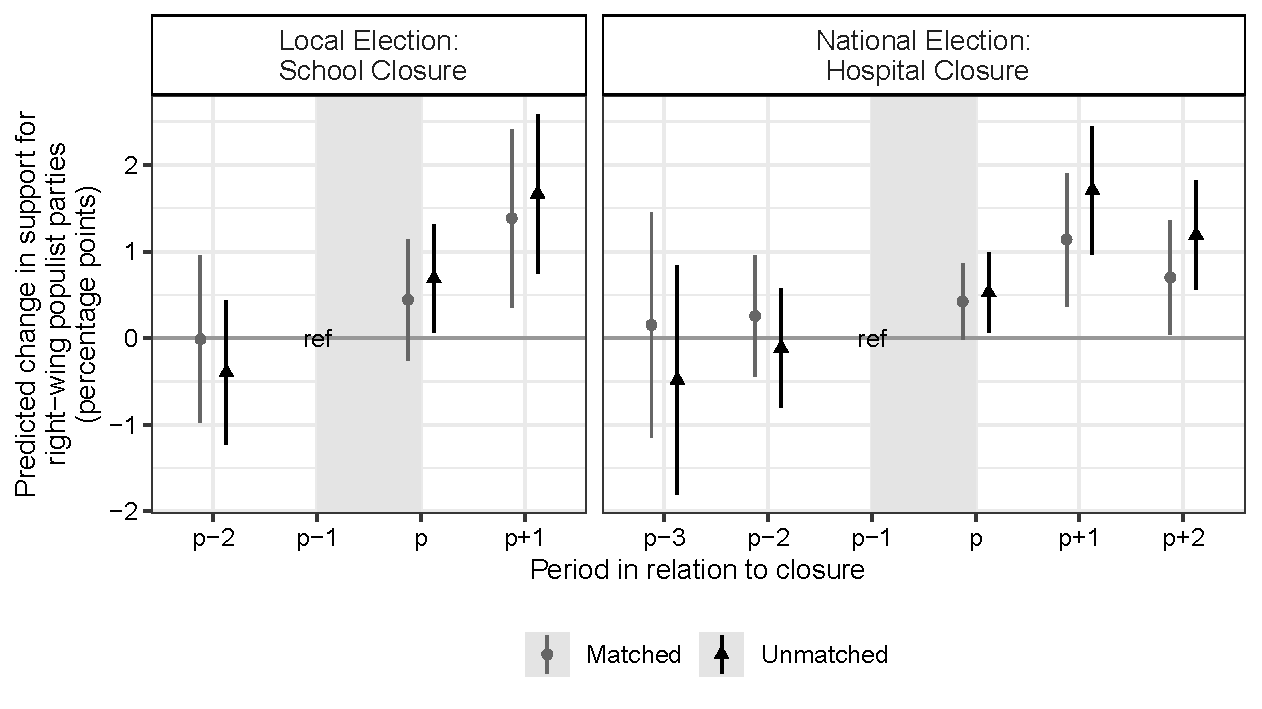
Voters in rural and peripheral areas have increasingly turned away from mainstream parties and towards right-wing populist parties. This paper tests the extent to which political decisions with adverse local effects — such as school and hospital closures — can explain this electoral shift. I theorize that political decisions such as these substantiate a perception of a disconnect between “ordinary” people and the politicians in power in day-to-day experiences. Using data on 315 school closures and 30 hospital closures in Denmark from 2005 to 2019 in a generalized difference-in-differences design, I find that mayors lose about 1.6 percentage points of the valid votes in areas where they close a school. Furthermore, I find that right-wing populist parties increase their support in both local and national elections when a local school or hospital is closed. These findings provide insight into the electoral consequences of political decisions with adverse local effects and thus contribute to our understanding of the rise of right-wing populism.
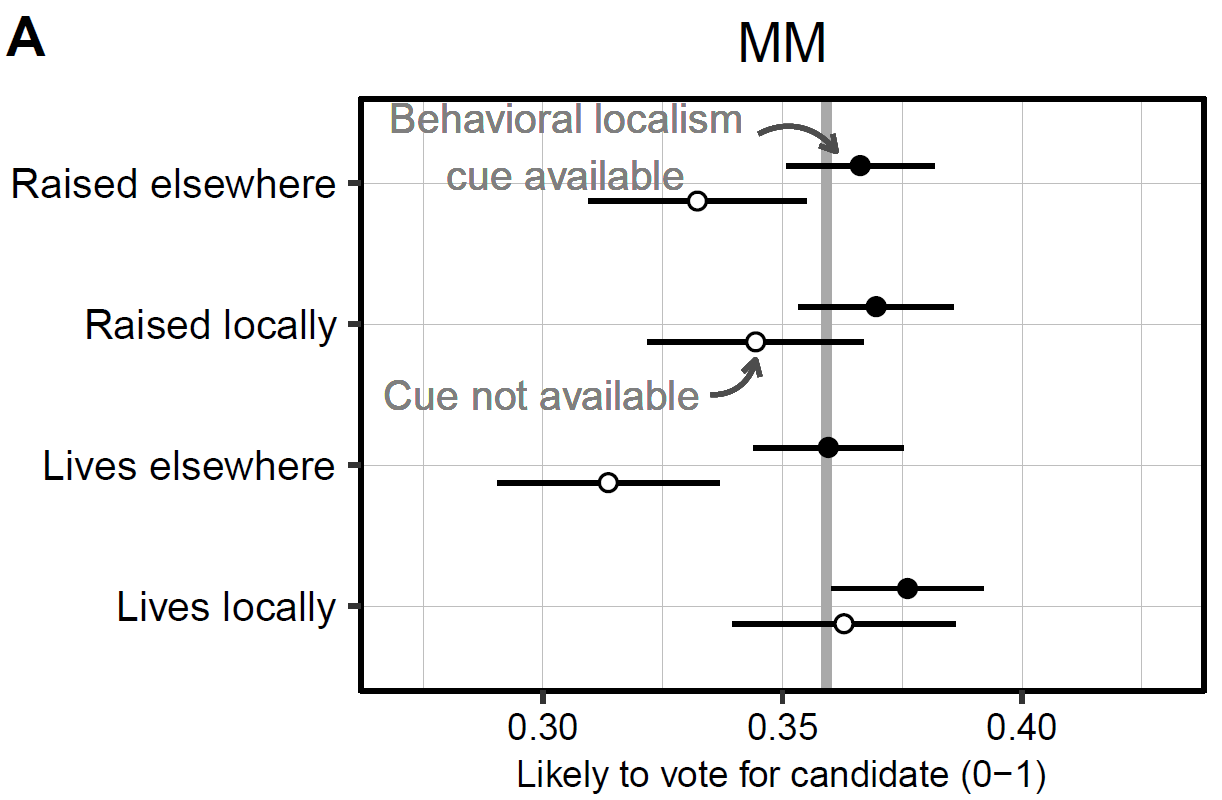
Political candidates enjoy a well-documented electoral advantage near their place of residence. But knowing that voters prefer candidates who live nearby does not explain why this is the case. What inferences do voters make about local candidates that make them so universally attractive? In this study, I distinguish two well-established theoretical explanations in a conjoint experiment conducted in Denmark. Do people prefer local candidates because of in-group favoritism, or do voters prefer local candidates because they expect them to favor their local area once in office? By independently varying signals of candidates’ (1) behavioral localism and (2) symbolic localism, I estimate the importance of each for voters’ preferences for local candidates. I find that voters’ preference for candidates who live nearby is driven in part by a preference for candidates who spend most of their time looking out for voters’ local interests. While I also find that voters prefer candidates who signal their commitment to the local in-group, these preferences appear to be unrelated to voters’ preference for candidates who live locally. Thus, I find that voters seem to prefer local candidates because of their behavioral localism, while I find no evidence that voters prefer local candidates because of their symbolic localism.
Journal of Political Institutions and Political Economy2024with Martin Vinæs Larsen
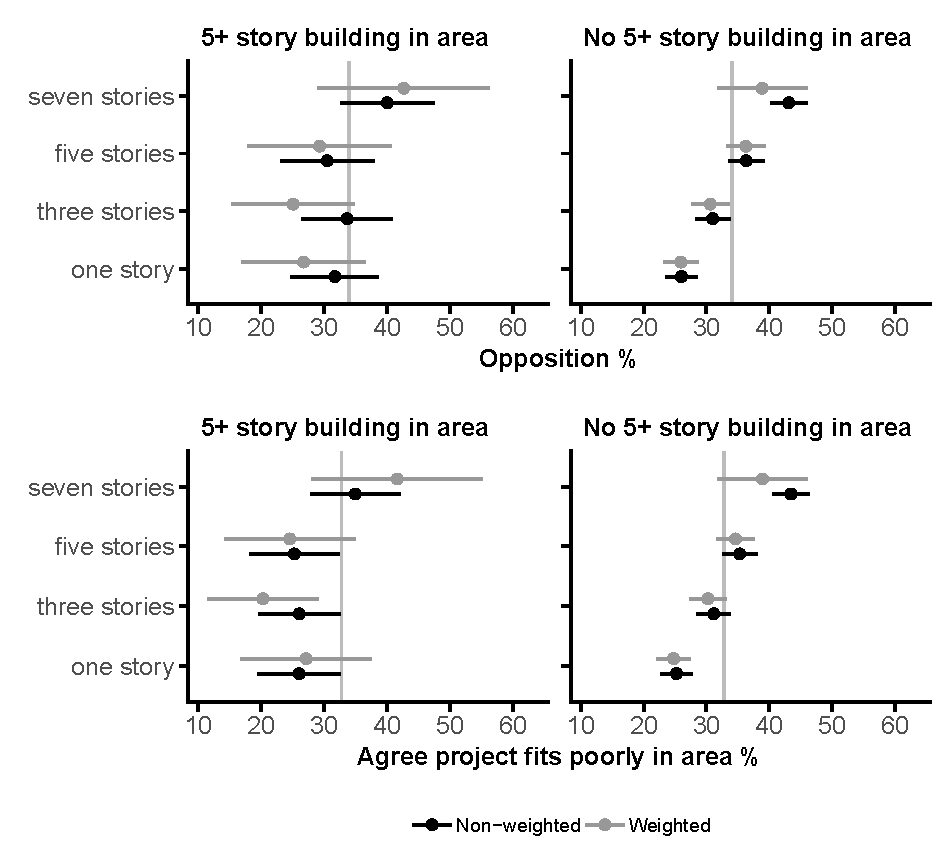
New apartment buildings offer potential relief from high housing costs, but they encounter significant local opposition. Using a vignette survey experiment, we explore why citizens oppose the construction of apartment buildings. We find limited evidence that this opposition stems from concerns over congestion or out-group bias. Citizens tend to oppose taller buildings irrespective of whether they attract more or undesirable residents. Instead, opposition to apartment buildings seems to be driven by local preservationism. Respondents do not think that tall buildings fit into their predominantly low-rise neighborhoods. To substantiate the importance of preservationism, we zoom in on projects that were proposed near another apartment building. Here, respondents agree that apartment buildings fit in and they oppose them less. These results may help explain why cities sprawl rather than densify, and why it is difficult to build affordable housing in expensive cities.